
Beyond Curriculum: Inside AstraGen’s K5 Learning Ecosystem
It’s 9:00 a.m. in a primary classroom.
A teacher begins a lesson.
The room is filled with eager young learners, each bringing their own curiosity, strengths, and way of understanding the world.
One child learns best through colourful visuals.
Another prefers listening carefully to every explanation. Another would prefer to read and understand the lesson on their own.
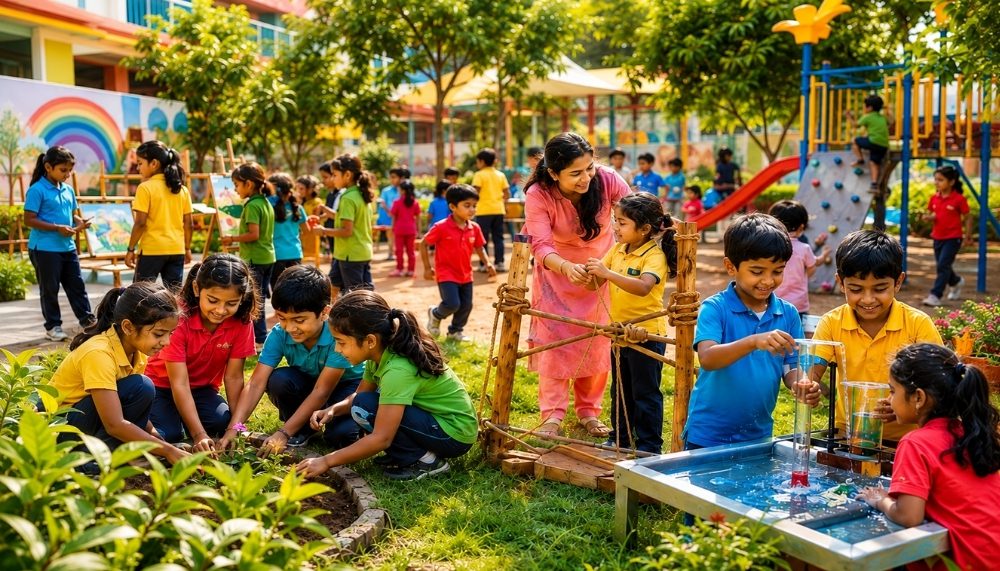
A fourth understands concepts only when they can touch, build, experiment, and experience them firsthand.
As the lesson unfolds, the teacher faces a familiar challenge:
How do you create a meaningful learning experience for every child in the room?
In today’s rapidly evolving educational landscape, delivering content is no longer enough.
The real challenge is creating an ecosystem where curriculum, technology, teaching methodologies, assessments, and stakeholder engagement work together seamlessly.
At AstraGen, this challenge became our opportunity.
Over more than a decade of educational research, classroom observations, curriculum development, and continuous innovation, we have worked towards building something larger than a curriculum and more meaningful than a collection of digital tools.
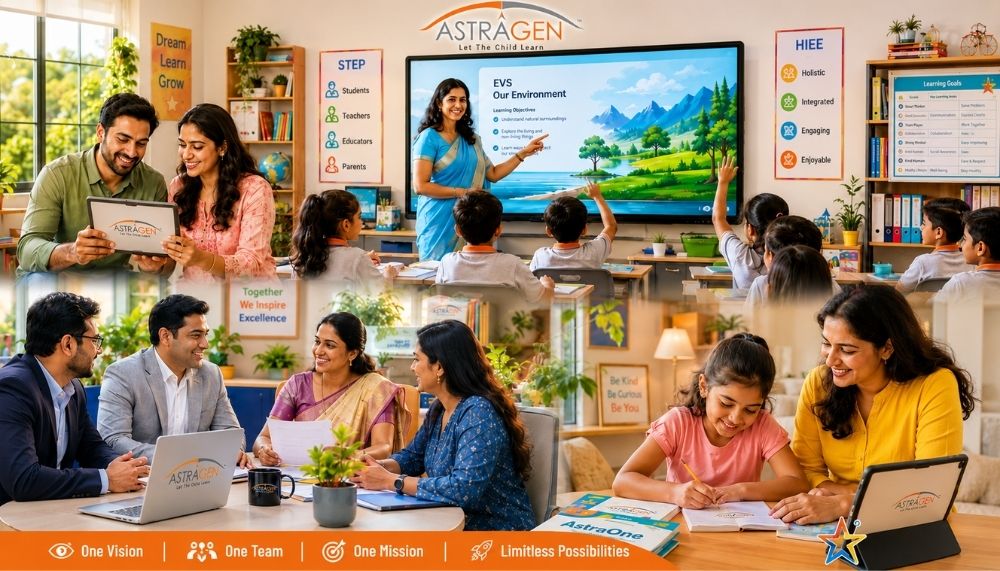
We set out to create a complete learning ecosystem—one that supports students, empowers teachers, strengthens schools, engages parents, and prepares children for the future.
Looking Beyond Individual Solutions
Schools often rely on disconnected systems—curriculum from one provider, digital tools from another, assessments from a third, and parent engagement that remains fragmented.
While each component may be valuable on its own, meaningful learning happens when all these elements work together.
Children do not experience education in fragments. Their learning journey is continuous, connected, and influenced by multiple stakeholders every day.
This understanding shaped AstraGen’s approach to educational design.
Rather than creating isolated products, we focused on building an integrated ecosystem where every component supports and strengthens the others.
Inside the Ecosystem: A Single Idea, Five Connected Systems
Consider a single learning objective—say, a Grade 3 child learning to identify fractions.
In a fragmented system, this exists as one page in a textbook, one slide in a presentation, and one line in a report card, with little connecting them.
Inside the AstraGen ecosystem, that same objective travels further:
Curriculum design maps the concept to age-appropriate outcomes, aligned with NEP 2020 and NCF 2023.
Diagnostic assessment identifies where each child stands before the lesson begins, so teaching isn’t aimed at an average student who doesn’t exist.
Classroom resources—visual, auditory, and hands-on—let the same concept reach the child who learns by seeing, the one who learns by listening, and the one who needs to build it with their hands.
Teacher support ensures the person delivering the lesson has the training and guidance to adapt in real time, not just a script to follow.
Parent engagement closes the loop, turning a classroom concept into a conversation that continues at home.
This is what “ecosystem” means in practice—not a slogan, but one idea passing through five connected systems instead of five disconnected ones.
The Human Side of Education

Technology continues to reshape education through artificial intelligence, adaptive learning systems, digital platforms, and immersive learning experiences.
Yet one thing remains unchanged—education is fundamentally human.
A great learning experience still depends on inspired teachers, supportive parents, visionary school leaders, and curious students.
Technology should strengthen these relationships, not replace them.
That is why AstraGen’s approach has always focused on empowering people first and supporting them with the right tools, resources, and systems.
The future of education will be shaped by schools that successfully balance innovation with human connection, academic excellence with creativity, technology with empathy, and knowledge with application.
As we continue our journey, AstraGen remains committed to helping schools create learning experiences that are engaging, meaningful, personalised, and future-ready.
That means helping students do more than complete a syllabus—it means helping them develop confidence, curiosity, creativity, communication skills, critical thinking, and a lifelong love for learning.
Because educational transformation is not achieved through isolated tools or short-term solutions.
It happens when students, teachers, educators, parents, curriculum, technology, and support systems come together with a shared purpose.
And that is the ecosystem we continue to build every day—one that empowers every child to learn, grow, and thrive.
Every Child Can Learn.
Every Learning Journey Matters.
This is the first of many stories from inside AstraGen’s classrooms, research, and design process.
If you’d like to see how this ecosystem comes to life, explore AstraOne and AstraPlus—or get in touch to talk to our team.